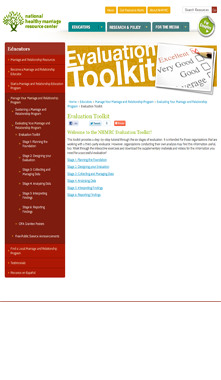
Ongoing evaluation of your healthy marriage program will allow you to identify what's working and what's not in terms of meeting your program’s overall goals and objectives. This information will significantly enhance your ability to effectively manage and grow your program.
Program evaluation allows you to answer questions such as:
- Are you serving your target population?
- What are the demographics and characteristics of your participants?
- Do your participants attend all of your classes and graduate or do you experience participation drop-off?
- Do participants like your class?
- Do they report any changes in their attitudes or opinions concerning marriage?
- Did they learn the skills and concepts you were teaching?
- Do they intend to change their behavior as a result of participating in your class?
Evaluation methods range from hiring an expert from a research firm or university to conduct a sophisticated evaluation to using simple tools, forms, and methods to evaluate your program’s activities and effectiveness.
Below are resources you can use to develop your own evaluation program. If you are an OFA grantee, visit the Community of Practice (password-protected) for more evaluation tips and tools.
Evaluation Textbooks and General Resources
Back to top
Survey Design Resources
Back to top
Data Analysis Resources
Back to top
Measurement Resources
- Child Trends, "What is Healthy Marriage? Defining the Concept"
- Family & Child Well-Being Research Network Publications
- "Conceptualizing and Measureing a Construct of Marital Values" (PDF)
- FRIENDS National Resource Center for CBCAP (PDF)
- Ahlborg, T., L.O. Persson and L.R.M. Hallberg. (2005). Assessing the quality of the dyadic relationship in first-time parents: Development of a new instrument. Journal of Family Nursing, 11(1): 19-37.
- Cron, E.A. (2000). Couple Rating Scale: Clarifying problems. The Family Journal, 8(3): 302-304.
- Jones, W.H., J.M. Adams, and J.O. Berry. (1995). A psychometric exploration of marital satisfaction and commitment. Journal of Social Behavior and Personality, 10(4): 923-932.
- Lowell, K.E. and J.J. Conley. (1987). Personality and compatibility: A prospective analysis of marital stability and marital satisfaction. Journal of Personality and Social Psychology, 52(1), 27-40.
- Mikulincer, M., et al. (2002). Attachment security in couple relationships. A systemic model and its implication for family dynamics. Family Process, 41(3): 405-434.
- Moore, K.A. and L.H. Lippman (Eds.). (2005). What do children need to flourish? Conceptualizing and measuring indicators of positive development. The Search Institute Series on Developmentally Attentive Community and Society, Vol. 3
- Roach, A.J., L.P. Frazier, and S.R. Bowden. (1981). The Marital Satisfaction Scale: Development of a measure for intervention research. Journal of Marriage and the Family, 43(3): 537-546.
- Vaughn, M.J. and M.E.M. Baier. (1999). Reliability and validity of the Relationship Assessment Scale. American Journal of Family Therapy, 27(2): 137-147.
- West, C.E. (2005). Clinical utility and validation of the Couple's Communicative Evaluation Scale. Psychological Reports, 97(2): 599-622.
Back to top
Evaluation Model Design Resources
Back to top
Logic Model Resources
Back to top
Human Subjects and Institutional Review Board Resources
Back to top
Reporting and Results Implications Resources
Back to top
A Selection of Peer-Reviewed, Published Marriage Education Evaluations
- Carroll, J.S. and W.J. Doherty. (2003). Evaluating the effectiveness of premarital prevention programs: A meta-analytic review of outcome research. Family Relations, 52(2): 105-118.
- Gardner, S.P., K. Giese, and S.M. Parrott. (2004). Evaluation of the connections: Relationships and marriage curriculum. Family Relations, 53(5): 521'527.
- Hahlweg, K., et al. (1998). Prevention of marital distress: Results of a German prospective longitudinal study. Journal of Family Psychology, 12(4): 543-556.
- Halford, W.K, et al. (2004). Benefits of flexible delivery relationship education: An evaluation of the "Couple CARE" program. Family Relations, 53(5): 469-476.
- Hawkins, A.J., et al. (2006). The "Marriage Moments" program for couples transitioning to parenthood: Divergent conclusions from formative and outcome evaluation data. Journal of Family Psychology, 20(4): 561-570.
- Markman, H.J., et al. (2004). Use of an empirically based marriage education program by religious organizations: Results of a dissemination trial. Family Relations, 53(5): 504-512.
- Nickols, S.A., D.G. Fournier and S.Y. Nickols. (1986). Evaluation of a preparation for marriage workshop. Family Relations, 35(4): 563-571.
- Rowden, T.J. S.M. Harris and R.F. Stahmann. (2006). Group premarital counseling using a premarital assessment questionnaire: Evaluation from group leaders. American Journal of Family Therapy, 34(1): 47-61.
- Shapiro, A.F. and J.M. Gottman. (2005). Effects on marriage of a psycho-communicative-educational intervention with couples undergoing the transition to parenthood: Evaluation at 1 year post-intervention. Journal of Family Communication, 5(1): 1-24.
- Stanley, S.M., et al. (2005). Dissemination and evaluation of marriage education in the Army. Family Process, 44(2): 187-201.
Back to top